
Troubleshooting Pentair Pool Heater Issues
Pentair Pool Heater Troubleshooting: Common Sensor Problems, Error Codes & Fixes
If you’re looking for Pentair pool heater troubleshooting help because your heater won’t heat, starts and then shuts off, or displays a service or sensor error, the problem may involve a temperature sensor, safety switch, wiring issue, or another condition the heater is detecting.
But don’t replace a sensor just because an error appears.
Pentair MasterTemp and Max-E-Therm heaters use several sensors and safety controls to monitor water flow, air flow, water temperature, and exhaust temperature. A shutdown can indicate a failed component, damaged wiring, poor water flow, an airflow restriction, or another condition the sensor is correctly detecting.
This Pentair pool heater troubleshooting guide covers some of the most common sensor-related problems, how to identify the component involved, and what to check before ordering a replacement.
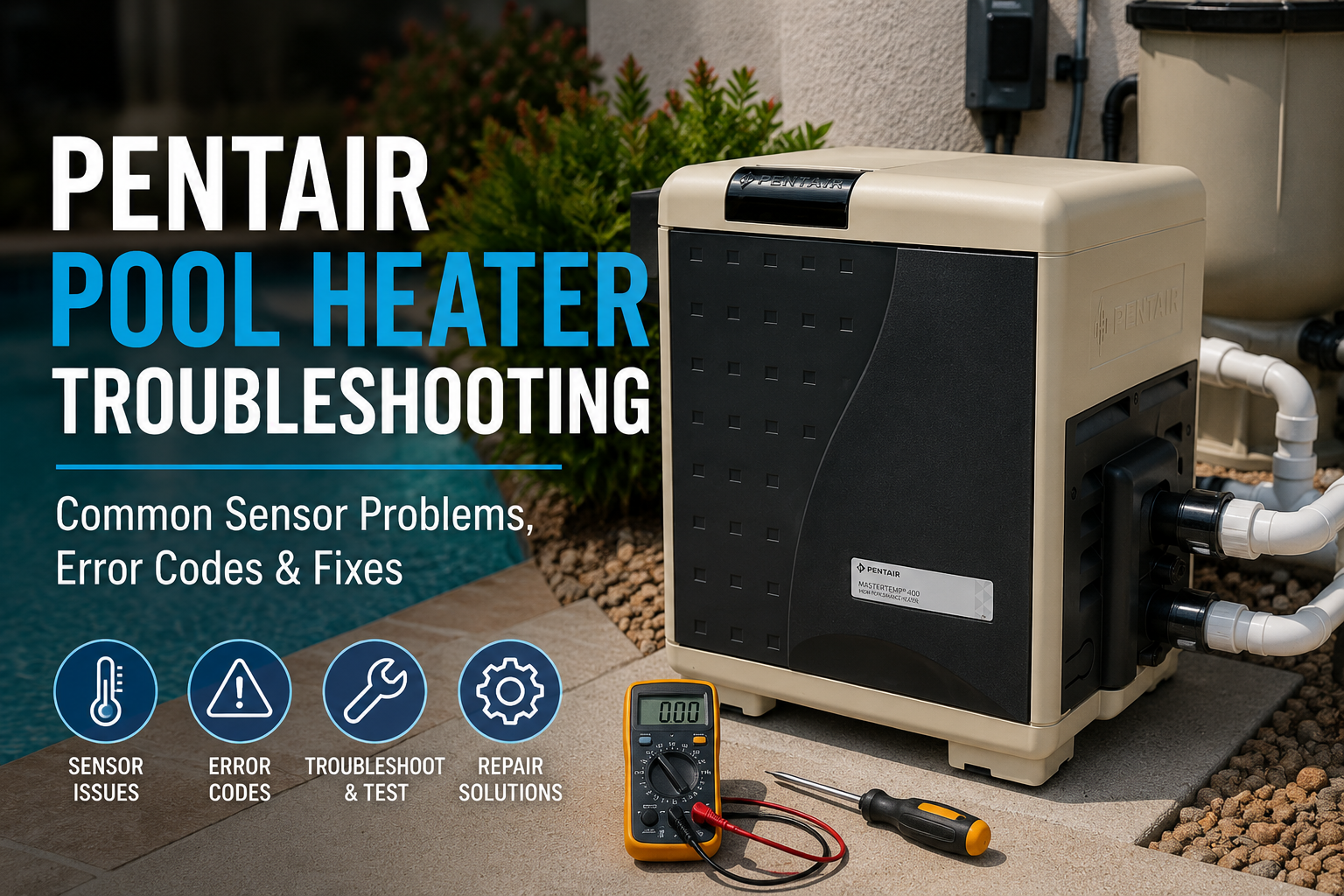
Pentair Pool Heater Troubleshooting: Start With the Error Code
A good Pentair pool heater troubleshooting process starts with the diagnostic code rather than immediately replacing a sensor.
| Error or Diagnostic | What It Points To | What to Check |
|---|---|---|
| SFS / ERR SFS | Stack flue temperature circuit | Stack flue sensor, wiring, exhaust temperature, heat exchanger and water flow |
| E05 | Stack flue sensor circuit | Sensor, connector and wiring |
| E06 | Stack flue sensor circuit | Sensor, connector and wiring |
| THERMISTOR | Water temperature sensor circuit | Thermistor and wiring |
| AFS | Air flow switch | Blower, airflow switch, tubing and intake/exhaust restrictions |
| PS | Water pressure switch | Pump operation, filter, water flow and pressure switch |
| HLS | High limit switch | Water flow, overheating, thermal regulation and high-limit switch |
| AGS | Automatic gas shutoff switch | Overheating, water flow and heater safety controls |
The exact display and diagnostic system can vary by heater model and production year, so always compare the code with the troubleshooting information for your specific heater.
For additional manufacturer guidance, refer to the official Pentair MasterTemp Installation and User’s Guide.
Common Symptoms of Pentair Pool Heater Problems
Sensor and safety-control problems can show up in several ways:
- Heater ignites but shuts down shortly afterward
- Heater cycles on and off repeatedly
- SFS, E05, or E06 error appears
- Displayed water temperature does not match the actual pool temperature
- Heater shuts off before reaching the set temperature
- Heater continues heating beyond the expected set point
- Heater will not fire even though the circulation pump is operating
- Service Heater light appears
- Heater operates intermittently
The symptom alone usually isn’t enough to identify the failed part. The error code, heater model, wiring condition, water flow, and operating conditions should be considered together.
Pentair Stack Flue Sensor Problems
The stack flue sensor monitors the temperature of the heater’s exhaust gases. It is part of the heater’s safety system and helps protect the heater from excessively high flue temperatures.
On compatible MasterTemp and Max-E-Therm heaters, Pentair part number 42002-0024S is a commonly used stack flue sensor. Pentair also identifies the 42002-0024S Stack Flue Sensor in its official MasterTemp electrical-system replacement-parts documentation.
Shop the Pentair 42002-0024S replacement stack flue sensor
Symptoms That May Point to the Stack Flue Sensor
Common indications include:
- SFS or ERR SFS diagnostic
- E05 error
- E06 error
- Heater shutting down unexpectedly
- Intermittent operation
- Heater failing to start after repeated attempts
However, an SFS shutdown does not always mean the sensor itself has failed.
If the heater’s actual exhaust temperature is getting too high, the sensor may be doing exactly what it is supposed to do. Problems with water flow, the thermal regulator, heat exchanger scaling, soot buildup, or combustion can also lead to an SFS shutdown.
Pentair’s own troubleshooting procedure checks conditions such as high exhaust temperature, the thermal regulator, heat exchanger condition, and water flow before automatically concluding that the stack flue sensor should be replaced.
How to Test a Pentair Stack Flue Sensor
Before testing or servicing the heater, turn off electrical power and follow the shutdown procedure specified for your heater model. Allow the heater to cool completely.
For applicable MasterTemp heaters using the 42002-0024S-style stack flue sensor:
- Disconnect the sensor from the heater circuit.
- Set your multimeter to measure resistance.
- Measure across the sensor terminals.
- Inspect the connector and wiring for corrosion, loose terminals, heat damage, or broken conductors.
Pentair’s MasterTemp troubleshooting procedure specifies approximately 3.5 to 4.0 megohms when checking the stack flue sensor. An open or shorted circuit may indicate a failed sensor.
If the sensor tests correctly, continue troubleshooting the wiring and heater system rather than replacing the sensor automatically.
Pentair Water Thermistor Problems
The water thermistor measures the temperature of the water entering the heater and sends that information to the control system.
If the thermistor provides an incorrect temperature reading, the heater may think the pool has already reached its set temperature or may cycle incorrectly.
For compatible MasterTemp applications, the Pentair 42001-0053S is a commonly used water thermistor.
Shop the Pentair 42001-0053S replacement thermistor
Older MiniMax Plus and PowerMax heaters may use the Pentair 470180 thermistor probe.
Shop the Pentair 470180 replacement thermistor
Symptoms of a Failing Water Thermistor
A thermistor problem may cause:
- Incorrect water temperature displayed
- Heater shutting off before reaching the set temperature
- Heater cycling excessively
- Heater failing to call for heat
- Inconsistent pool or spa temperatures
- Temperature-related diagnostic faults
Before replacing the thermistor, inspect its connector and wiring. Corroded terminals, loose connections, or damaged wiring can create symptoms similar to a failed sensor.
How to Test a Pool Heater Thermistor With a Multimeter
A thermistor is a temperature-sensitive resistor, which means its resistance changes as its temperature changes.
To perform a basic check:
- Shut off power to the heater.
- Disconnect the thermistor from the heater circuit.
- Set the multimeter to resistance, or ohms.
- Measure resistance across the thermistor terminals.
- Compare the reading with the specifications or resistance table for your exact heater and sensor.
A healthy thermistor should show a resistance value that changes smoothly as temperature changes. For example, gently warming the sensor should cause the resistance reading to move rather than stay fixed or jump unpredictably.
A reading of zero, infinite/OL, or an erratic value can indicate a sensor or wiring problem.
Always compare the measured resistance with the specifications for your exact sensor rather than relying on one universal resistance value.
Pentair Pool Heater Troubleshooting for Short Cycling
If your Pentair heater fires, runs briefly, shuts down, and then repeats the cycle, it is tempting to replace the first sensor associated with the fault.
That can lead to replacing a good component without correcting the real problem.
When performing Pentair pool heater troubleshooting for short cycling, check these basic conditions first:
- Confirm the circulation pump is operating.
- Make sure the pool water level is adequate.
- Check the pump and skimmer baskets.
- Check whether the filter needs cleaning.
- Verify that the appropriate valves are open.
- Look for the heater’s error code or diagnostic indicator.
- Inspect accessible sensor wiring and connectors.
If the heater displays an AFS fault, troubleshoot the air-flow system rather than the stack flue sensor.
If it displays an SFS-related fault, determine whether the sensor circuit has failed or the heater is experiencing a genuine high exhaust-temperature condition.
Replacing a Pentair Pool Heater Sensor
Replacement procedures vary by heater model and sensor.
For many temperature sensors, the basic process involves shutting down the heater, disconnecting power, allowing the heater to cool, accessing the sensor, disconnecting its electrical connection, removing the old sensor, and installing the correct replacement.
Before ordering, verify:
- Heater model
- Existing sensor part number
- Connector style
- Replacement-part compatibility
Do not bypass a failed safety switch or temperature sensor to keep the heater operating. These components are part of the heater’s safety system.
Repairs involving the burner, gas valve, fuel pressure, combustion system, internal high-voltage wiring, or persistent overheating should be handled by a qualified pool-heater service professional.
Replacing Multiple Pentair Heater Sensors and Switches
If you are servicing an older MasterTemp or Max-E-Therm heater and multiple original safety components need replacement, purchasing the components together may be more convenient than ordering each part separately.
Our Pentair pool heater repair kit includes replacements for several commonly serviced components:
- 42002-0024S stack flue sensor
- 42001-0053S water thermistor
- 42001-0060S water pressure switch
- 42002-0025S automatic gas shutoff switch
- 42001-0063S high limit switch
Always confirm compatibility with your exact heater before ordering.
Frequently Asked Pentair Pool Heater Troubleshooting Questions
What does SFS mean on a Pentair pool heater?
SFS refers to the stack flue sensor circuit. The stack flue sensor monitors exhaust temperature as part of the heater’s safety system.
An SFS fault can be caused by the sensor or wiring, but it can also indicate an actual overheating condition. If the sensor and wiring check correctly, water flow, the thermal regulator, heat exchanger, exhaust, and combustion system may require further diagnosis.
What does E05 mean on a Pentair MasterTemp heater?
E05 is associated with the stack flue sensor circuit. Inspect the sensor, wiring, and electrical connections as part of the troubleshooting process.
What does E06 mean on a Pentair MasterTemp heater?
E06 is also associated with the stack flue sensor circuit. Check the sensor and wiring for a possible short or other electrical fault.
What does AFS mean on a Pentair heater?
AFS stands for Air Flow Switch. It is separate from the stack flue sensor.
An AFS diagnostic can point to issues involving the blower, air-flow switch, switch tubing, wiring, combustion-air intake, or exhaust path.
Can I bypass the stack flue sensor?
No. The stack flue sensor is a heater safety component. Bypassing it can allow the heater to operate without the protection the sensor was designed to provide.
Diagnose the cause of the fault and correct the underlying problem instead.
Why does my Pentair pool heater turn on and then shut off?
Several conditions can cause a Pentair heater to start and then shut down, including poor water flow, a dirty filter, a sensor or switch fault, overheating, an airflow problem, or damaged wiring.
Start with the heater’s diagnostic code and basic water-flow checks before replacing parts.
How do I know which Pentair heater sensor I need?
Start with the exact heater model and the part number installed in your heater. Different heater families and production versions may use different components.
If you’re unsure, contact our USA-based support team with your heater model, existing part number, and a photo of the original sensor or connector. We can help narrow down the correct replacement.
Need a Replacement Pentair Pool Heater Sensor?
Wholesale Sensors carries replacement temperature sensors, switches, and heater components for many Pentair pool and spa heater applications.
Before ordering, compare your heater model and existing part number with the replacement listing. A clear photo of the original component, connector, and part-number label can also help identify the correct replacement.
Shop Pentair pool heater replacement parts or contact our support team if you need help narrowing down the correct part.